Data is the New Gold

Data Is the New Gold (And You're Sitting on a Mine)
Everyone's arguing about AI. Is it hype? Is it real? Will it take our jobs or just make better autocomplete?
Here's what I know after months of daily AI use: the skeptics and believers are both missing the point. The question isn't whether AI is useful. It's whether you have what AI needs to be useful.
And that thing is data. Your data.
The Empty Toolbox Problem
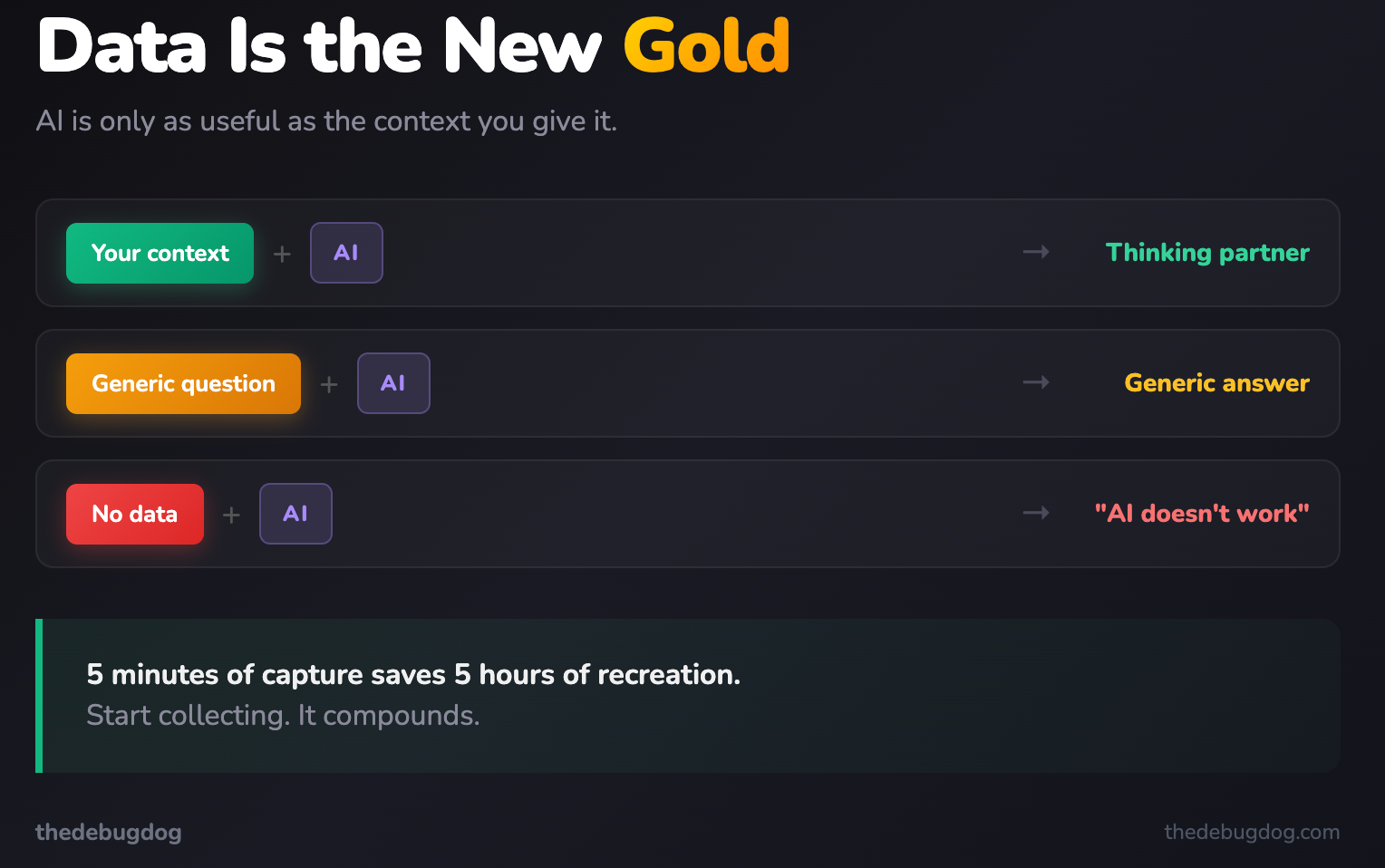
Most people who say "AI doesn't work for me" are trying to use a power tool without raw materials. They open ChatGPT, type a generic question, get a generic answer, and conclude AI is overrated.
But AI isn't a magic oracle. It's an amplifier. Feed it nothing, get nothing useful back. Feed it rich context about your specific situation, and suddenly you have a thinking partner that actually understands your problems.
The difference between "AI is useless" and "AI saves me hours daily" is almost never the tool. It's the input.
Your Meetings Are Marketing Gold
Here's a concrete example. Last week I recorded a 40-minute internal call where we discussed a complex client delivery challenge and how we solved it. Just raw conversation. People talking through problems, proposing solutions, debating tradeoffs.
I fed that transcript to Claude. Within minutes, it drafted a case study that would have taken our marketing team days to write from scratch. Not because AI is magic, but because all the substance was already in that conversation. The expertise, the problem framing, the solution details, the results. AI just extracted and structured it.
You're having conversations like this every week. You're solving real problems for real clients. That's content. That's marketing material. That's proof of your expertise.
You're just not capturing it.
The Tough Call That Made You Better
Had a difficult client conversation? Made a mistake and recovered? Navigated a tricky negotiation?
Most people let these moments evaporate. Maybe they complain to a colleague, process it for a day, then move on. Waste of good data.
Instead: take 5 minutes after the call. Write down what happened, what worked, what didn't. Be honest. Nobody's reading this but you and your AI partner.
Now you have raw material. Feed it to Claude. Ask: "What patterns do you see? What could I do differently? What's the underlying dynamic here?"
This isn't journaling. It's systematic learning with an AI thinking partner that never forgets, never judges, and can connect dots across hundreds of your notes.
Building Your AI Partner
Anthropic has something called Claude Skills. It's essentially a way to create a custom AI partner that knows your context deeply.
I built one with my professional background, my company's positioning, our typical clients, our service offerings, the problems we solve. Now when I have a tough situation, I don't start from zero. I have an AI that already understands my business context and can think through problems with me.
Tough negotiation coming up? I walk through the scenario with my AI partner. Pricing question? It knows our market positioning. Strategy decision? It can play devil's advocate with actual context.
But this only works because I invested time upfront to feed it information. No data, no partner. Just another generic chatbot telling you to "consider all stakeholders" and "align with business objectives."
What to Collect
Start simple. The habit matters more than perfection.
Meeting recordings. Especially ones where you discuss challenges and solutions. These become case studies, training materials, process documentation.
Post-call notes. After any significant conversation — client, team, vendor — spend 5 minutes capturing what happened. What decisions were made? What tensions emerged? What did you learn?
Decision logs. When you make a hard call, write down why. What options did you consider? What tradeoffs did you accept? Six months later, you'll have a goldmine for reflection and AI analysis.
Company context. Your positioning, ideal client profile, competitive advantages, common objections, typical engagement structure. This is the foundation for any AI partner that actually knows your business.
None of this requires fancy tools. Voice memos. Notes app. Whatever captures the moment without friction.
Why Most People Won't Do This
I'll be honest: this sounds simple but most people won't actually do it. Not because it's hard. Because it requires a small habit change, and habit changes feel annoying.
After a tough call, you want to decompress, not document. After a long meeting, you want to move on to the next thing. Recording another voice memo feels like one more task on an already full day.
Here's the reframe: you're not adding work. You're capturing value that already exists. That meeting happened. That insight occurred. That problem got solved. The work is done. You're just making it reusable instead of letting it evaporate.
Five minutes of capture can save five hours of recreation later. That's the math.
The Compound Effect
Here's what happens when you build this habit over months.
Your AI interactions get better because you can reference specific context. "Remember that pricing discussion we had last month? Here's a similar situation." Claude actually has something to work with.
Your marketing gets easier because you have a library of real stories and solutions. No more staring at blank pages trying to manufacture case studies. The content already exists — you just need to shape it.
Your decision-making improves because you can quickly synthesize past experiences with current challenges. Pattern recognition across your own history. "Last time we faced something like this, we did X and it worked because Y."
You stop asking AI generic questions and start having genuine strategic conversations. The AI becomes less like a search engine and more like a colleague who's been in every meeting you've had.
And here's the kicker: your competitors probably won't do this. They'll keep having the same generic AI experience, wondering why "AI doesn't work" for their business. Meanwhile, you're building a compounding advantage every single day.
The Real Competitive Advantage
The people who will get the most value from AI aren't the ones chasing the latest model. They're not debating GPT-4 versus Claude versus Gemini.
They're the ones systematically capturing and organizing their expertise so AI has something meaningful to work with.
Data is the new gold. And every day you're not collecting it, you're leaving value on the ground.
Comments ()